When discussing electrical engineering and manufacturing, two terms are frequently used interchangeably: wire harness and cable assembly. While they serve a similar fundamental purpose – transmitting power and electrical signals – they are distinctly different components designed for entirely different environments.
Understanding the key differences between a wire harness and a cable assembly is crucial for engineers, procurement managers, and manufacturers. Making the wrong choice can lead to equipment failure, safety hazards, and unnecessary manufacturing costs.
What is a Cable Assembly?
A cable assembly is a group of wires or cables encased within a single, highly durable outer sheath. This outer jacket is typically made from heavy-duty materials like thick rubber, polyurethane, or thermoplastic elastomer (TPE). The primary purpose of this robust construction is sheer protection.
Unlike a wire harness, where you can often see the individual colored wires bundled together, a cable assembly completely conceals the inner wires, leaving only the rugged exterior and the end connectors visible.
The Primary Differences Explained
The easiest way to understand the distinction is by looking at their intended environments and structural design.
1. Environmental Protection and Durability
Cable Assemblies are built for extreme, harsh environments. Their heavy-duty jackets are designed to withstand significant physical abuse, extreme temperatures, moisture, dust, and corrosive chemicals. They are ideal for outdoor use or heavy machinery where the cable might be exposed to the elements or physical wear.
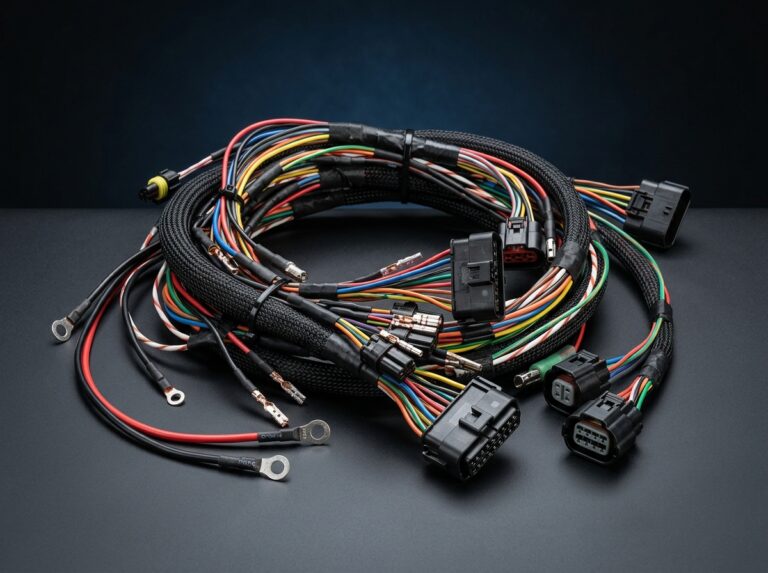
Wire Harnesses, on the other hand, provide a much lower level of environmental protection. The zip ties, lightweight heat shrink, or electrical tape used to bind a wire harness are meant to keep the wires organized, not to protect them from severe external damage. They are almost exclusively used internally, protected by the outer casing of a machine, vehicle, or electrical panel.
2. Flexibility and Routing
Because wire harnesses lack a thick outer jacket, they are highly flexible. This flexibility allows engineers to route them through tight spaces, corners, and complex internal structures of devices like automobiles or medical equipment. A single wire harness can have dozens of “breakouts” (points where individual wires exit the main bundle to connect to different components).
Cable assemblies are generally much stiffer and heavier, restricting their routing capabilities but maximizing their ruggedness.
How-To: Choose the Right Solution for Your Project
If you are designing a new electrical system, follow these steps to decide which component you need:
- Evaluate the Environment: Ask yourself where the wires will be located. If they will be exposed to weather, heavy friction, or chemicals, you must choose a cable assembly. If they are safely hidden inside a chassis, a wire harness is sufficient.
- Assess Spatial Constraints: Measure the space available for routing. If you need extreme flexibility and have tight corners, a custom wire harness is the only viable option.
- Consider Weight and Cost: Wire harnesses are generally cheaper and significantly lighter than cable assemblies. For applications like aerospace or automotive (where weight is critical), harnesses are highly preferred.
- Determine Connection Points: If you need a simple point-A-to-point-B connection, a cable assembly works well. If you have a complex system with multiple sensors, relays, and power sources requiring dozens of breakouts, you need a wire harness.
For related reading, see our article on the fundamental components that make up a basic wire harness. You can also learn more about our manufacturing capabilities. These practices are consistent with standards such as ISO 9001.
For a real-world example of a fully engineered cable assembly rather than a simple harness, take a look at our Industrial Automation Control Cable Assemblies.
Frequently Asked Questions
Generally, no. Unless a wire harness is enclosed in a weatherproof conduit or specifically designed with heavy-duty protective loom, it will rapidly degrade if exposed to moisture, UV rays, and harsh weather conditions.
Yes, cable assemblies are typically more expensive due to the cost of the heavy-duty jacketing materials and the specialized manufacturing processes required to extrude the protective sheath over the wires.
It is very common to use both in a single product system! For example, an industrial machine might use a heavy-duty cable assembly to plug into the factory wall for main power, but internally, it relies on a complex wire harness (like the one discussed in our previous article on wire harness basics ) to distribute that power to its internal motors and circuit boards.