When discussing electrical systems, most people focus on the wires themselves. However, a wire is useless if it cannot securely attach to a power source or a receiving device. This is where the true heroes of the electrical assembly come in. Understanding the role of connectors and terminals in wire harnesses is essential for anyone involved in product engineering or manufacturing.
While often used interchangeably by laymen, terminals and connectors are two very different components that work together to create a reliable electrical bridge.
What is a Terminal?
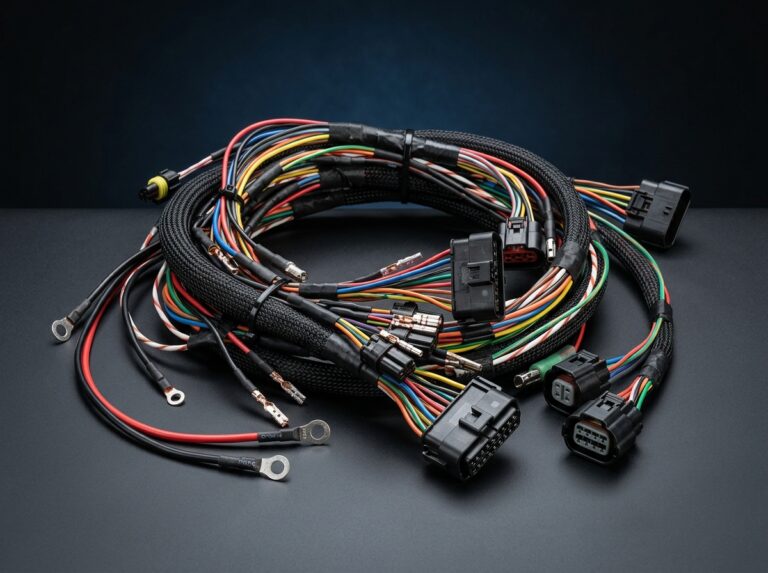
A terminal is the metal contact point that is physically attached to the end of a stripped wire. It is the component that actually conducts the electricity from the wire to the next connection point.
Terminals are almost always attached using a mechanical crimping process. The “wings” of the terminal are folded tightly over the copper strands of the wire, creating a “cold weld” that is incredibly strong and highly conductive. Terminals come in various shapes depending on their application, such as ring terminals (for bolting to a battery post), spade terminals, and the most common in harnesses: pin and socket terminals.
What is a Connector?
A connector (often called a connector housing) is the rigid, non-conductive plastic or ceramic shell that holds the metal terminals in place.
If you have twenty wires that need to plug into a motherboard, you don’t want to plug in twenty individual metal pins one by one – the risk of crossing wires is too high. Instead, all twenty terminals are inserted and locked into a single plastic connector housing. This allows a technician to “plug in” all twenty wires simultaneously with a single “click.”
The Importance of the “Mate”
Connectors are designed in pairs: a male (plug) and a female (receptacle). When they are pushed together, they “mate.”
A high-quality connector serves several vital functions beyond just organizing the wires:
- Polarity Protection: Most connectors are “keyed” (shaped asymmetrically) so they can only be plugged in one way, preventing catastrophic reverse-polarity accidents.
- Environmental Sealing: In automotive and marine harnesses, connectors feature internal silicone gaskets that seal out water, oil, and dust when mated.
- Vibration Resistance: Connectors use mechanical locking latches that “click” into place, ensuring the connection does not vibrate apart inside a moving vehicle or running machinery.
How-To: Identify a Bad Connection
If an electronic device is failing intermittently, the connector is often the culprit. Here is how to check it:
- Visual Inspection: Unplug the connector and look inside. Are any of the metal terminals bent, pushed back, or showing green/white corrosion?
- The “Tug Test”: Gently tug on the wires going into the back of the connector. A properly seated terminal will not move. If a wire pulls out, the terminal was not fully locked into the housing.
- Check the Latch: Ensure the plastic locking latch on the outside of the connector housing is not snapped off.
- Related reading: Learn more about wire gauge
- Related reading: Learn more about extreme temperature
For related reading, see our article on why strain relief is critical for connector longevity. You can also learn more about our quality control process. These practices are consistent with standards such as ISO 9001.
For an application where connector and terminal selection is mission-critical, see our MIL-DTL-27500 Avionics & Cockpit Cable Assemblies.
Frequently Asked Questions
This is caused by high electrical resistance. If a terminal is loose or corroded, the electrical current has to “work harder” to jump the gap, creating friction and extreme heat, which eventually melts the surrounding plastic connector.
The plastic housing can usually be reused. You can use a specialized “pin extraction tool” to reach inside the connector, depress the locking tang on the broken terminal, and pull it out. You can then crimp a new terminal onto the wire and slide it back into the old housing.
Absolutely not. There are tens of thousands of proprietary connector shapes patented by companies like Molex, TE Connectivity, and Delphi. A Molex plug will not mate with a TE receptacle.