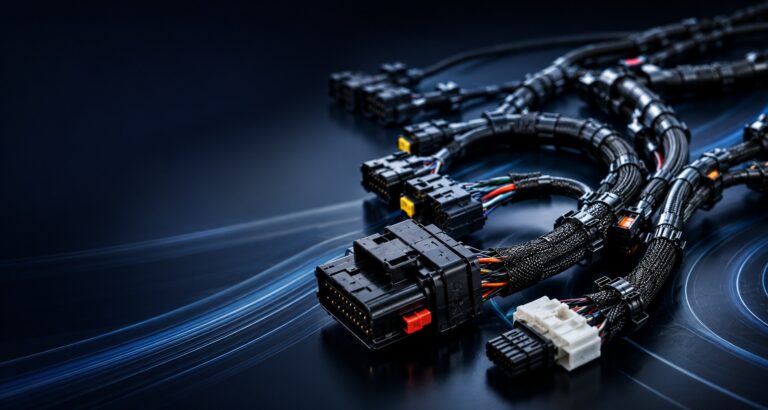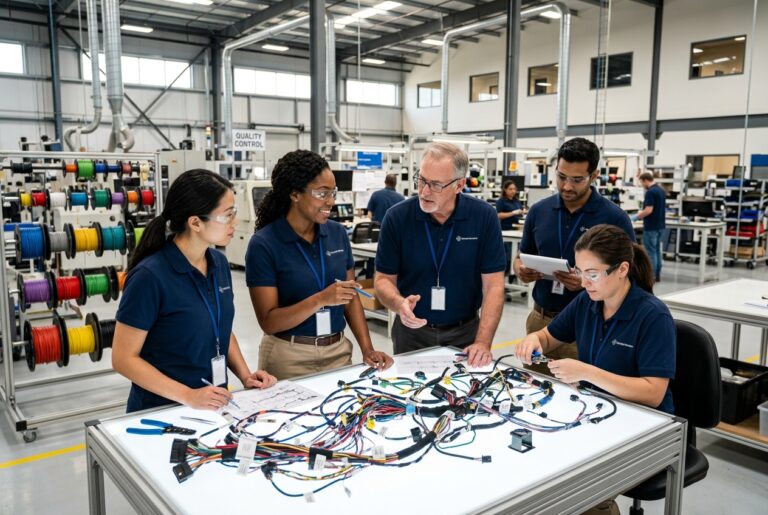
A custom wire harness is more than just a collection of wires connected at both ends. It is a carefully engineered physical structure designed to fit perfectly within a specific machine, vehicle, or device. To achieve this, engineers must utilize specific wire routing and bundling methods.
Proper bundling keeps the harness organized, prevents wires from sagging into moving parts, and protects the delicate copper conductors from physical abrasion.
Common Bundling Techniques
There is no single “best” way to bundle a wire harness. The choice depends entirely on the operating environment, budget, and flexibility requirements of the final product.
- Zip Ties (Cable Ties): The most common and cost-effective method. Zip ties are fast to apply and incredibly strong. However, they can create rigid “pinch points” if pulled too tight, potentially crushing the insulation of softer wires.
- Split Loom Tubing: A highly popular choice in automotive manufacturing. This corrugated plastic tubing is split down the middle, allowing wires to be easily inserted. It provides excellent protection against crushing and abrasion while remaining highly flexible.
- Tape Wrapping: Using specialized automotive cloth tape (like Tesa tape) or high-temperature PVC tape. Taping is excellent for creating a very tight, compact bundle, but it makes future repairs or modifications very difficult.
The Art of Cable Lacing
In high-reliability sectors such as aerospace, military, and naval engineering, traditional zip ties are often banned. Over decades of vibration, the hard plastic edge of a zip tie can slowly saw through wire insulation.
Instead, these industries rely on cable lacing. This is a traditional technique where technicians use a continuous piece of flat, waxed nylon or Kevlar twine to tie precise, evenly spaced knots around the wire bundle.
Lacing distributes the binding pressure evenly across a wider surface area, eliminating pinch points. While it is a slower, manual process that requires skilled labor, it produces the most durable, lowest-profile, and safest wire bundle possible.
How-To: Best Practices for Routing
Regardless of the bundling method you choose, always follow these fundamental routing rules when designing a harness:
- Maintain Bend Radius: Never bend a wire bundle sharply at a 90-degree angle. Follow the manufacturer’s recommended minimum bend radius (usually 4 to 6 times the outer diameter of the bundle) to prevent breaking the internal copper strands.
- Avoid Heat Sources: Route harnesses as far away from exhaust manifolds, motors, and high-wattage resistors as possible. If proximity is unavoidable, utilize heat-reflective sleeving.
- Separate Power and Data: Whenever possible, do not bundle high-amperage power cables with low-voltage data cables. The electromagnetic interference (EMI) from the power lines can corrupt the data signals. Route them parallel but separated by a few inches.
- Related reading: Learn more about wire gauge
- Related reading: Learn more about extreme temperature
For related reading, see our article on the role of relays and fuses within a complex wiring harness system. You can also learn more about our quality control process. These practices are consistent with standards such as ISO 9001.
Routing and bundling strategy is especially important in complex, moving assemblies such as our Heavy-Duty Robotic & Machine Wiring Harness.
Frequently Asked Questions
If the wire harness will be exposed to direct sunlight (e.g., solar panel arrays, agricultural equipment), you must use black, UV-stabilized zip ties. Standard white nylon ties will become brittle and snap within a year of UV exposure.
Yes, absolutely. A complex harness might use split loom tubing for the main trunk running under a chassis, switch to cloth tape where it passes through the firewall, and use small zip ties at the breakout points near the connectors.
A service loop is a small, intentional amount of slack left in the wire routing near the connector. This ensures the wire is not under constant tension and allows technicians to easily unplug and reconnect the device during future maintenance.