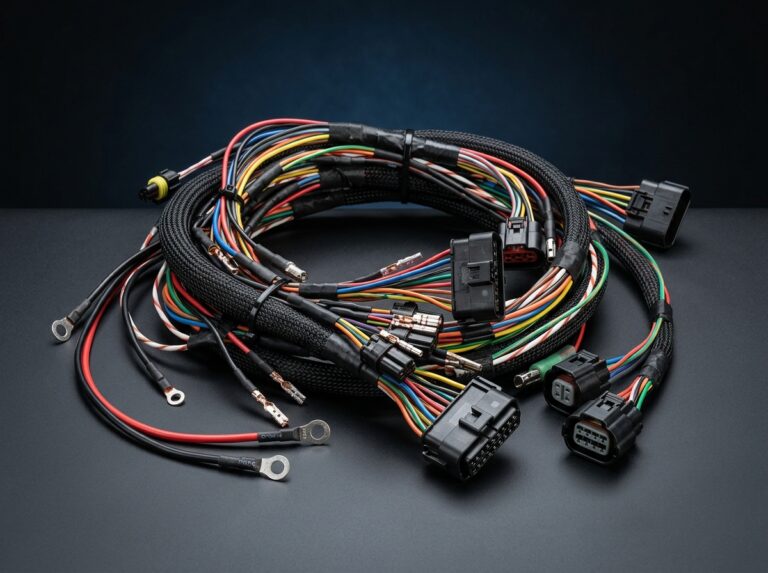
For decades, if you needed to permanently join two wires together, you reached for a soldering iron. However, if you look inside the wire harness of any modern automobile or aerospace vehicle, you will rarely find solder. Instead, you will find solid blocks of fused copper. Understanding why ultrasonically welded splices are superior to solder explains the massive shift in modern manufacturing standards.
Ultrasonic welding is a solid-state process that uses high-frequency acoustic vibrations (sound waves) to fuse metals together under pressure, without melting them.
The Fatal Flaw of Soldering
Soldering involves melting a third, completely different metal (usually a tin/lead or tin/silver alloy) over the twisted copper wires to act as an electrical “glue.” While excellent for printed circuit boards, soldering is a liability in a wire harness for several reasons:
- Embrittlement: Solder wicks up into the copper strands via capillary action. This turns the highly flexible stranded wire into a rigid, solid bar of metal just past the joint. Under vibration, the wire acts as a lever and snaps exactly where the solder ends.
- Galvanic Corrosion: Mixing dissimilar metals (copper wire, tin solder, flux acids) creates a microscopic battery in the presence of moisture. The joint will slowly corrode itself from the inside out over the years.
- Heat Resistance: Solder melts at relatively low temperatures (around 370°F/188°C). If a short circuit causes the wire to overheat, the solder joint can literally melt apart, disconnecting the circuit before the fuse even blows.
The Ultrasonic Advantage
Ultrasonic welding completely eliminates the need for a third filler metal.
When the high-frequency vibration is applied, the friction strips away the microscopic oxide layer on the individual copper strands. The bare copper atoms are pressed so tightly together that they share electrons, forming a true metallurgical bond. The hundreds of individual strands become a single, solid piece of pure copper.
Benefits include:
- Zero Resistance: Because it is pure copper-to-copper, there is zero added electrical resistance at the joint.
- Incredible Strength: An ultrasonic weld is physically stronger than the parent wire itself. If you try to pull it apart, the wire will snap somewhere else before the weld fails.
- No Embrittlement: The welding process happens in milliseconds and generates very little heat. Therefore, there is no heat-affected zone, and the wire remains perfectly flexible immediately adjacent to the weld block.
- Related reading: Learn more about wire gauge
- Related reading: Learn more about extreme temperature
- Related reading: Learn more about connectors
Ultrasonic welding creates a splice by using high-frequency vibration to fuse conductor strands together at a molecular level, rather than relying on solder or a separate connector to join them. This produces a homogeneous, low-resistance joint with no added mass from solder or flux residue, and it eliminates the risk of a cold solder joint, which is one of the more common causes of intermittent connections in traditionally soldered harnesses. Ultrasonically welded splices are especially valuable in automotive and aerospace applications where consistent, repeatable joint quality across thousands of units matters more than the flexibility of a hand-soldered repair.
For related reading, see our article on important materials used in high-quality wiring harnesses. You can also learn more about our custom wire harness products. These practices are consistent with standards such as ISO 9001.
Ultrasonic welding is the industry-standard joining method we rely on for our Battery Pack & Charging Cable Assemblies.
Frequently Asked Questions
Cost. A professional soldering iron costs $100. An entry-level industrial ultrasonic wire welder costs upwards of $20,000 to $40,000. It is strictly a high-volume manufacturing technology.
Yes! This is one of the massive advantages of the technology. Because it is a solid-state weld (no melting), you can successfully weld dissimilar metals like aluminum battery cables directly to copper terminals without the galvanic corrosion issues of traditional welding.
A perfectly executed mechanical crimp is excellent and forms a gas-tight seal. However, for splicing multiple wires together (e.g., 5 ground wires joining into 1 main ground), an ultrasonic weld is statistically more reliable over a 20-year lifespan than a massive crimp barrel.