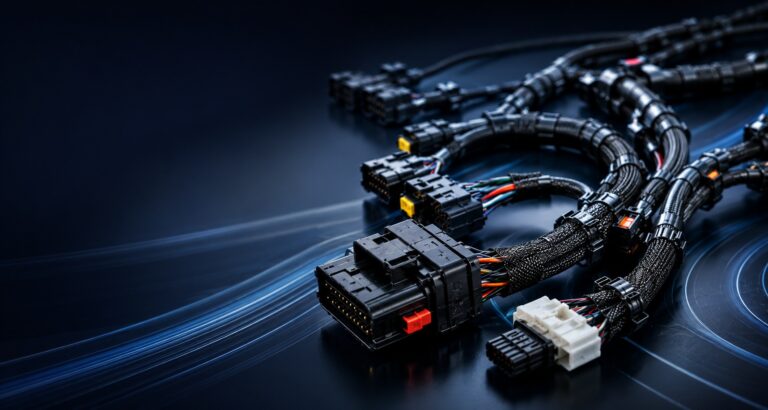
When replacing a damaged electrical system or upgrading a vehicle, buyers are often faced with a choice that significantly impacts…
Author: XinHarness Engineering Team
The XinHarness Engineering Team consists of wire harness design and quality engineers with hands-on manufacturing experience across automotive, medical, aerospace, marine, and industrial programs. Our production processes are certified to ISO 9001, IATF 16949, ISO 13485, and AS9100D, and our team regularly publishes technical guidance based on real crimping, testing, and harness design work performed in our own facility.
Imagine opening a complex machine to find a massive bundle of 50 completely identical black wires. Diagnosing an electrical fault…
In heavy machinery, off-road vehicles, and industrial equipment, engine vibration is constant. If a wire harness is allowed to rub…
You cannot determine if a wire harness is good just by looking at it. A tiny sliver of copper bridging…
In modern electrical systems, vehicles and machines are packed with high-power motors, alternators, and ignition coils. These devices act like…
Water and electricity do not mix. In automotive, marine, and outdoor industrial environments, moisture is the absolute worst enemy of…
A wire harness can be built with the highest quality copper, perfectly crimped terminals, and extreme-temperature insulation. Yet, it can…
When a wire harness operates in an engine bay, deep underwater, or in outer space, standard plastic connectors and wire…
A wire is not a perfect conductor; it is essentially a very long, very weak resistor. When electricity travels over…
When designing a wire harness for a vehicle, most engineers obsess over heat resistance. However, for snowmobiles, aerospace applications, and…