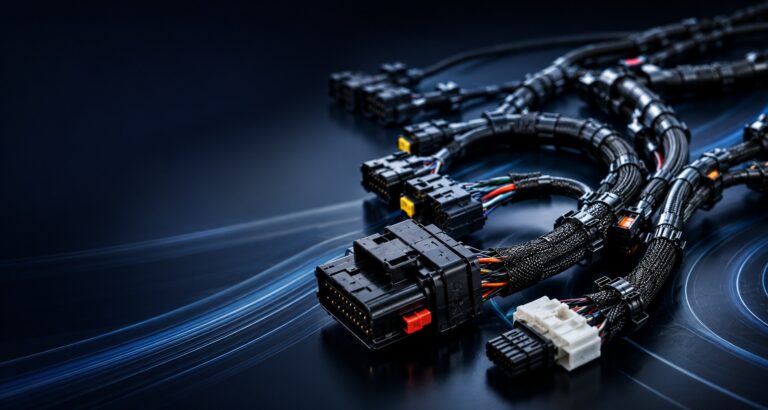
When a wire harness operates in an engine bay, deep underwater, or in outer space, standard plastic connectors and wire insulation materials are simply not enough to keep out moisture and prevent vibration damage. To achieve ultimate reliability, manufacturers rely on two advanced chemical processes. Understanding the role of potting and conformal coating in wire harnesses is essential for harsh-environment engineering.
While both processes aim to protect electronics, they are used in very different ways.
What is Potting?
Potting involves completely filling an enclosure (like a wire harness connector or a sensor housing) with a liquid resin that subsequently cures into a solid mass. The most common potting compounds are Epoxy, Polyurethane, and Silicone.
- Total Ingress Protection: Because the liquid flows into every microscopic crevice before hardening, a potted connector is 100% waterproof. It can be fully submerged in the ocean without shorting out.
- Vibration Immunity: The solid block of resin acts as a shock absorber. The delicate pins and crimps inside the connector cannot physically vibrate, eliminating metal fatigue.
- The Downside: It is permanent. Once a connector is potted with epoxy, it is impossible to repair. If one pin fails, the entire module must be thrown away. It also adds significant weight.
What is Conformal Coating?
Conformal coating is a thin, specialized polymeric film (usually acrylic, silicone, or urethane) that is sprayed or brushed directly onto a Printed Circuit Board (PCB) or exposed terminals. It “conforms” to the exact contours of the board.
- Lightweight Protection: Unlike heavy potting blocks, conformal coating adds almost zero weight, making it ideal for aerospace wire harness modules.
- Moisture and Dust Barrier: It prevents condensation, salt spray, and conductive dust from bridging the tiny gaps between circuits and causing shorts.
- Repairability: Many conformal coatings can be dissolved with specific chemical solvents or carefully burned through with a soldering iron, allowing technicians to repair the board later.
Choosing between potting and conformal coating usually comes down to how much protection a connection needs versus how much serviceability you’re willing to give up. Potting compound fully encapsulates a joint or connector, offering the best protection against moisture, vibration, and chemical exposure, but it makes future repairs essentially impossible without cutting away the material. Conformal coating provides a much thinner protective layer that guards against humidity and light contamination while still allowing components to be reworked if needed, making it the more common choice for circuit boards and connections that may require future service.
For related reading, see our article on how heat shrink tubing protects your wiring harness connections. You can also learn more about our custom wire harness products. These practices are consistent with standards such as ISO 9001.
Conformal coating and potting are standard protections we apply to sensitive builds like our Automotive Sensor & ADAS Wiring Harness.
Frequently Asked Questions
While high-temperature wire harness tape protects the bundle from ambient heat, it does not seal connectors. For extreme heat sealing, high-temperature silicone potting compounds are preferred over standard epoxy.
Because conformal coating is often totally transparent, manufacturers add a UV-fluorescent dye to the liquid. Under blacklight on the assembly line, quality control inspectors can easily see if the entire board was coated or if a spot was missed.
Yes, two-part epoxy or silicone potting kits are available for low-volume work. However, in industrial settings, potting must be done inside a vacuum chamber to suck out any trapped air bubbles before the liquid cures. Trapped air expands when heated, which can crack the solid resin.