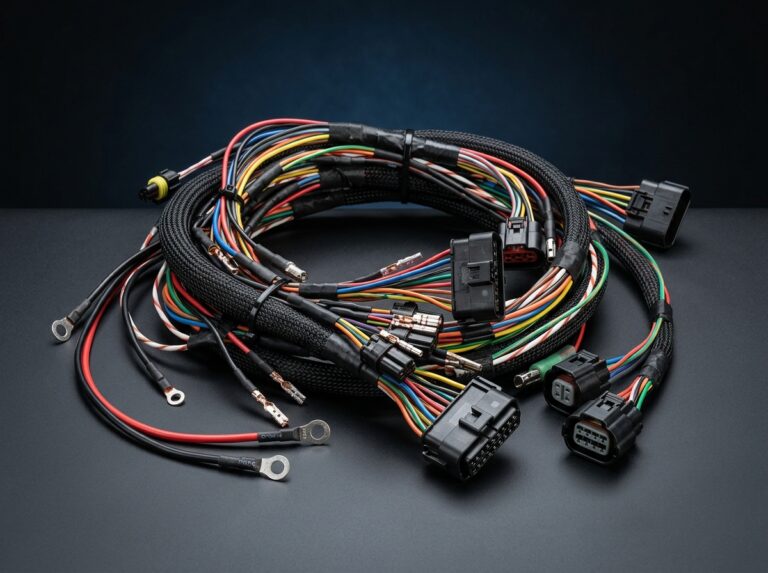
A wire is not a perfect conductor; it is essentially a very long, very weak resistor. When electricity travels over a long distance, some of that electrical pressure (voltage) is lost as heat due to the natural resistance of the copper. Knowing how to calculate voltage drop for long wire harness runs is essential to ensure your components receive enough power to function.
If you fail to account for this, you might end up with dim headlights, stalling fuel pumps, or overheating wires.

The Variables of Voltage Drop
Three main factors determine how much voltage you will lose over a wire run:
-
Wire Length
The longer the wire, the higher the resistance. A 20-foot wire will drop twice as much voltage as a 10-foot wire of the same thickness.
-
Wire Gauge (Thickness)
The thicker the wire, the lower the resistance. If you are experiencing voltage drop, you must choose a lower (thicker) wire gauge to allow more current to flow freely.
-
Current (Amperage)
The more current (amps) the component draws, the harder the electricity has to “push” through the wire, resulting in a higher voltage drop.
How-To: Calculate the Drop (The Formula)
Engineers use Ohm’s Law and specific resistance tables to calculate this precisely. Here is the step-by-step process:
- Find the Current: Determine the maximum amperage draw of your component (e.g., a fuel pump drawing 15 Amps).
- Find the Total Length: Measure the total circuit length. This includes the wire from the battery to the component, PLUS the ground wire returning to the battery. If it’s 15 feet there and 15 feet back, your total length is 30 feet.
- Find the Resistance per Foot: Look up the resistance of your chosen wire gauge. For example, 14 AWG wire has a resistance of roughly 0.0025 Ohms per foot. Therefore, 30 feet x 0.0025 = 0.075 Ohms total resistance.
- Calculate the Drop: Multiply the Current (Amps) by the Total Resistance (Ohms). Voltage Drop (V) = 15A * 0.075Ω = 1.125 Volts.
If your system starts at 13.8V, the component will only receive 12.67V. For most automotive applications, a voltage drop of 3% to 5% is considered acceptable.
Voltage drop calculations become especially important on long harness runs used in trucks, marine vessels, and agricultural equipment, where a run of twenty feet or more is common. As wire length increases, so does resistance, and even a wire gauge that’s adequate for the circuit’s current draw over a short distance can cause a significant voltage drop over a longer run, leading to dim lighting, sluggish motor performance, or unreliable electronics. The standard approach is to calculate the round-trip wire length (accounting for both the supply and return path) and size the gauge to keep voltage drop under 3% for critical circuits.
For related reading, see our article on common causes of wire harness failure and how to prevent them. You can also learn more about our manufacturing capabilities. These practices are consistent with standards such as ISO 9001.
Voltage drop calculations matter most on long power runs, such as those in our Marine Engine Room Power Distribution Harness.
Frequently Asked Questions
Absolutely. High-quality pure copper wire has lower resistance than cheap Copper-Clad Aluminum (CCA). You can learn more about the impact of copper wire quality here .
For DC applications like automotive wire harnesses, the difference in resistance between solid and stranded wire of the same gauge is negligible. However, you should always use stranded wire in vehicles for flexibility. Read more about stranded vs solid wires .
No! A bigger fuse will not push more voltage through a thin wire. It will only allow the wire to overheat and catch fire before the fuse blows. The only fix for voltage drop is thicker wire or a shorter run.