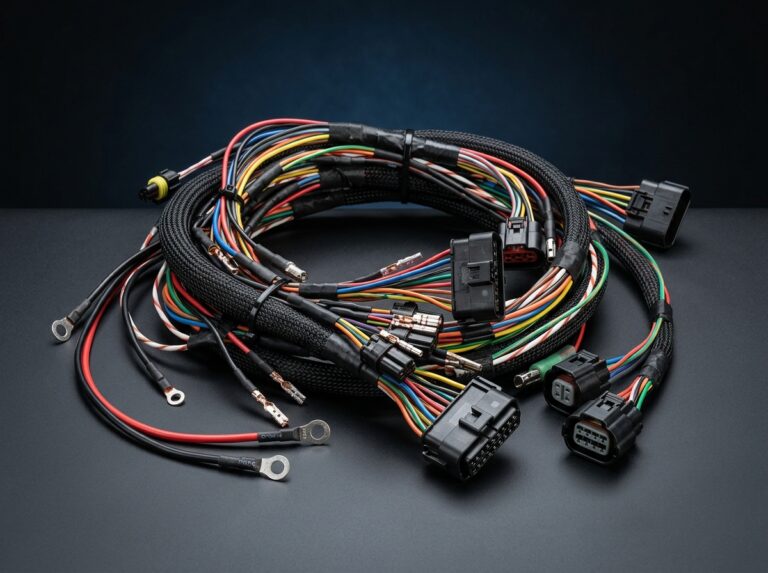
When designing a wire harness for a vehicle, most engineers obsess over heat resistance. However, for snowmobiles, aerospace applications, and heavy machinery operating in the arctic, the impact of extreme cold on wire flexibility and durability is an equally deadly engineering challenge.
Cold weather does not affect the copper conductor itself (in fact, copper becomes a slightly better conductor as it cools). The enemy of the cold is the plastic insulation surrounding it.

The Glass Transition Temperature
Every polymer (plastic) has a “glass transition temperature” (Tg). Above this temperature, the plastic is soft, pliable, and flexible. Below this temperature, the molecular structure locks into place, and the plastic becomes hard, brittle, and glass-like.
Standard PVC insulation, which is ubiquitous in cheap electronics, has a relatively high glass transition temperature. If you take a standard PVC wire outside in -20°F (-29°C) weather and bend it, the insulation will literally shatter like glass, instantly exposing the bare copper wire to the elements (and creating a massive short-circuit risk).
Engineering for the Arctic
To survive extreme cold, wire harnesses must be constructed from materials specifically engineered to remain flexible at sub-zero temperatures.
- Silicone Rubber: Silicone is the undisputed king of cold-weather flexibility. High-quality silicone wire remains perfectly soft and pliable even down to -76°F (-60°C). It is the material of choice for high-altitude weather balloons and arctic exploration rovers.
- PTFE (Teflon): While stiffer than silicone, PTFE has an incredible operating range. Aerospace-grade PTFE wire can survive down to an astonishing -328°F (-200°C) without cracking, making it suitable for cryogenic fluid systems and spacecraft.
- Cross-Linked Polyethylene (XLPE): For standard automotive applications (like TXL wire), XLPE offers a good middle ground. It is significantly more cold-resistant than standard PVC, usually rated down to -40°F (-40°C), while being much cheaper than silicone or PTFE.
How-To: Environmental Testing
How do manufacturers guarantee a wire harness will survive an Alaskan winter?
Before mass production, prototype harnesses are placed inside specialized environmental test chambers. The temperature is dropped to -40°C (or lower) and held there for 24 to 48 hours. Then, an automated machine (or a heavily bundled technician) physically bends, twists, and flexes the frozen wire harness repeatedly. If a single crack appears in the insulation during this cold bend test, the design fails.
- Related reading: Learn more about wire gauge
Extreme cold affects wire harnesses in ways that aren’t always obvious from a room-temperature inspection. Standard PVC insulation can become brittle and crack when flexed at sub-zero temperatures, and connector housings made from certain plastics can lose impact resistance in the cold, making them more susceptible to cracking during installation or vibration. Applications that routinely operate in cold climates, such as off-highway equipment or arctic-rated vehicles, typically call for cold-flexible insulation materials like silicone or specially formulated TPE compounds rated for continuous flexing well below freezing.
For related reading, see our article on understanding the difference between stranded and solid wires. You can also learn more about our custom wire harness products. These practices are consistent with standards such as ISO 9001.
Cold-weather flexibility is a core design requirement for exposed installations like our Offshore Platform Instrumentation Cable Assembly.
Frequently Asked Questions
No. Cold weather slows down the chemical reaction inside the battery itself, reducing its output capacity. The wires do not “drain” power in the cold.
If the manufacturer used standard PVC electrical tape to bundle the harness, that tape will turn rock hard in freezing temperatures. This is why premium automotive harnesses use woven cloth tape or specialized cold-weather Tesa tape.
If the wire shattered because it is operating below its temperature rating, wrapping it in standard tape will not fix the root cause. The tape itself will likely freeze and unstick. The wire must be completely replaced with a material rated for the environment (like silicone or XLPE).