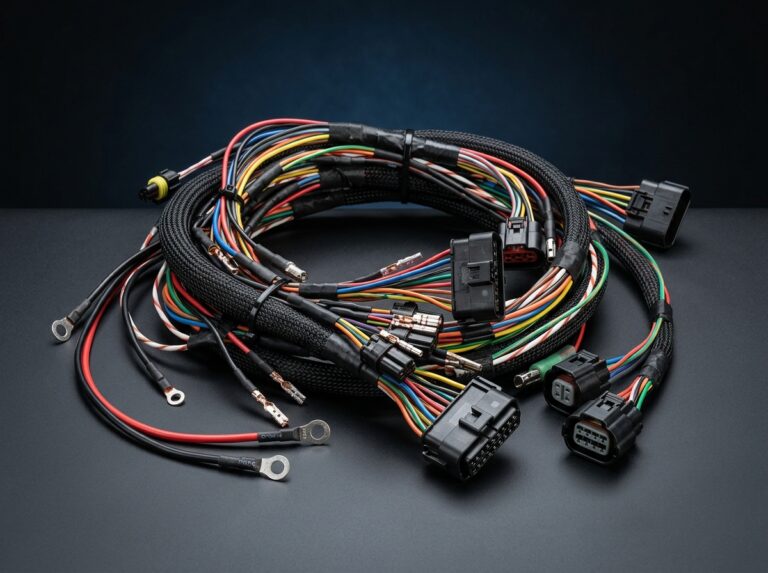
When purchasing or manufacturing a custom wire harness, it is tempting to look for ways to cut costs. The easiest way to slash prices is by using cheaper wire. However, the impact of copper wire quality on overall harness performance cannot be overstated. A harness is only as good as the metal inside it.
Using low-grade conductors in a demanding industrial or automotive environment will inevitably lead to voltage drops, erratic sensor behavior, and eventually, catastrophic thermal failure.
The Illusion of Copper: OFC vs. CCA
The biggest trap in the wire manufacturing industry is Copper-Clad Aluminum (CCA). To the naked eye, CCA wire looks exactly like pure copper because it has a micro-thin coating of copper plated over an aluminum core.
Oxygen-Free Copper (OFC): This is the gold standard for wire harnesses. OFC is refined to 99.99% purity. It offers maximum electrical conductivity, excellent corrosion resistance, and superb mechanical flexibility.
Copper-Clad Aluminum (CCA): CCA is significantly cheaper and lighter. However, aluminum is a much poorer conductor of electricity than copper (it has about 60% higher resistance). To carry the same amount of current safely, a CCA wire must be two gauge sizes thicker than an OFC wire.
The Danger of High Resistance
Electrical resistance is the enemy of any wire harness. When electrons struggle to push through a poor-quality conductor (like CCA wire or impure recycled copper), that kinetic energy is converted into heat.
In a tightly bundled wire harness, heat cannot easily escape. A single high-resistance wire carrying a heavy load will begin to glow like a toaster filament. This will melt the surrounding PVC insulation, leading to a dead short against neighboring wires or the metal chassis, instantly causing an electrical fire.
How-To: Ensure Quality Control in Wire Sourcing
How can you verify that your wire harness manufacturer is using high-quality OFC copper and not cutting corners?
- The Weight Test: Aluminum is much lighter than copper. If a spool of 10 AWG wire feels suspiciously lightweight compared to a known spool of pure copper, it is likely CCA.
- The Cut Test: Take a sharp pair of wire cutters and snip the end of the wire cleanly. Look at the cross-section under a magnifying glass. If you see a bright silver core surrounded by a thin orange ring, it is CCA. Pure copper will be orange all the way through.
- The Resistance Test: The most scientific method. Use a highly calibrated digital multimeter to measure the resistance of a specific length of wire (e.g., 100 feet). Compare the reading against the standard AWG resistance charts. If the resistance is significantly higher than the chart states, the copper is impure.
- Related reading: Learn more about wire gauge
For related reading, see our article on understanding the difference between stranded and solid wires. You can also learn more about our custom wire harness products. These practices are consistent with standards such as ISO 9001.
Copper quality has an outsized effect on signal integrity in high-density builds like our Networking & Data Center Cable Assemblies.
Frequently Asked Questions
Tinned copper wire is high-quality OFC copper where each individual strand has been coated in a micro-thin layer of tin. This prevents the copper from oxidizing (turning green) in highly corrosive environments. It is strictly required for marine applications.
While it will physically transmit a signal, it is highly discouraged. CCA wire is notoriously brittle. The aluminum core fatigues and snaps much faster than pure copper under vibration, leading to intermittent sensor faults that are incredibly difficult to diagnose.
That is copper oxide (verdigris). It occurs when moisture penetrates the insulation and reacts with bare copper over time. Oxide is an insulator, not a conductor. If you find green copper in a wire harness, that section must be cut out and replaced.