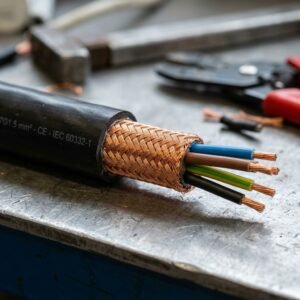

Overview
Wing, engine inlet, and probe de-icing systems require robust power delivery and precise temperature sensing to prevent ice accumulation across the full range of flight altitudes and weather conditions.

Design & Construction
High-Current Heating Element Power Cable
Heavy-gauge, high-temperature conductors deliver sustained power to wing leading-edge and engine inlet heating elements without excessive voltage drop.
Precision Ice Detection Sensor Wiring
Low-noise sensor circuits carry ice detection and surface temperature data to the anti-icing controller with the accuracy needed for timely activation.
Manufacturing Process
Built under AS9100D quality management with current-load and continuity testing, supporting de-icing system OEMs and airframe integrators across fixed-wing and rotorcraft platforms.

Typical Applications
- Wing leading-edge heater wiring
- Engine inlet anti-ice cabling
- Pitot probe heater harnesses
- Ice detection sensor interconnects
- Windshield anti-ice control wiring
Common installations include Wing leading-edge heater wiring, Engine inlet anti-ice cabling, and Pitot probe heater harnesses, where flight-critical reliability and stringent weight optimization are the primary design drivers. The same base design can also be adapted for Ice detection sensor interconnects and Windshield anti-ice control wiring with minor changes to connector type or cable length.
Technical Specifications
Standard configurations are available with the following technical specifications; custom configurations outside these ranges can be discussed with our engineering team. Wire Gauge: AWG 16 – 6. Conductor Count: 4 – 30 circuits. Insulation: High-temp, high-current fluoropolymer. Temp Range: -65°C to +200°C. Current Capacity: Up to 100A per heating zone. Signal Type: Precision ice detection sensor lines. Connector Standard: MIL-spec circular, launch-qualified.
Quality & Certification
Manufactured under AS9100D and ISO 9001 certification, with current-load validation matched to de-icing system power delivery requirements.
Customization & Lead Time
Standard lead time for the Aircraft De-Icing & Anti-Icing System Wiring Harness is 6–8 weeks prototype, 3–4 weeks production reorder. Connector type, cable length, and conductor configuration can be customized to match your exact application, including MIL-spec connector alternatives and shielding options for specific avionics or airframe integration requirements. Contact our engineering team with your drawings or requirements for a project-specific quote.
Why XinHarness
De-icing and anti-icing harnesses run on the same AS9100D-certified lines as our wing and flight surface programs, extended for high-current heating applications. See the Aerospace industry page, or request a quote for your project. For related technical background, see our article on the impact of extreme temperatures on wire harness performance.
Frequently Asked Questions
All aerospace harnesses, including the Aircraft De-Icing & Anti-Icing System Wiring Harness, are manufactured under AS9100D quality management and can be built to MIL-DTL-27500 wire and connector specifications on request.
Every Aircraft De-Icing & Anti-Icing System Wiring Harness unit undergoes continuity, insulation resistance, and dielectric withstand testing, with additional environmental and vibration testing available for flight-critical applications.
Yes. Connector types, wire gauge, shielding, and routing length can all be customized to match your specific airframe and installation requirements — contact our engineering team with your drawings or specifications.