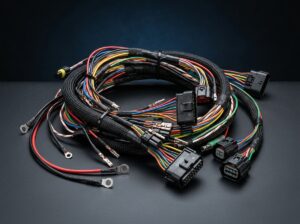

Overview
EV charging circuits carry high current at the charge port and onboard charger, requiring cable assemblies engineered for both power delivery and communication signal integrity.

Design & Construction
High-Current Power Cable Design
Heavy-gauge, high-temperature conductors handle sustained AC and DC fast-charging current between the charge port, onboard charger, and battery pack.
Integrated Communication Signal Pairs
Shielded CAN and PLC communication pairs run alongside power conductors in the same assembly, keeping charge-control signaling clean during high-current charging events.
Manufacturing Process
Built under IATF 16949 process controls with hipot, current-load, and continuity testing on every assembly, supporting EV OEMs and charging system integrators.

Typical Applications
- Charge port to onboard charger cabling
- Onboard charger to battery pack wiring
- DC fast-charge inlet assemblies
- Charge communication signal pairs
- Charging status indicator wiring
Common installations include Charge port to onboard charger cabling, Onboard charger to battery pack wiring, and DC fast-charge inlet assemblies, where vibration resistance and long-term durability under continuous thermal cycling are the primary design drivers. The same base design can also be adapted for Charge communication signal pairs and Charging status indicator wiring with minor changes to connector type or cable length.
Technical Specifications
Standard configurations are available with the following technical specifications; custom configurations outside these ranges can be discussed with our engineering team. Wire Gauge: AWG 10 – 2. Conductor Count: 2 – 12 power + signal pairs. Insulation: High-temp XLPE, high-voltage rated. Temp Range: -40°C to +125°C. Voltage Rating: Up to 800V DC fast-charge systems. Shielding: Shielded CAN/PLC communication pairs. Current Capacity: Up to 250A continuous.
Quality & Certification
Manufactured under IATF 16949 and ISO 9001 certification, with high-current safety testing suited to AC and DC fast-charging system requirements.
Customization & Lead Time
Standard lead time for the Automotive Charging Port & Onboard Charger Cable Assembly is 5–7 weeks prototype, 2–3 weeks production reorder. Connector type, cable length, and conductor configuration can be customized to match your exact application, including alternative connector families, wire gauge, and shielding to match OEM or Tier 1 platform specifications. Contact our engineering team with your drawings or requirements for a project-specific quote.
Why XinHarness
Charging cable assemblies share the same battery interconnect expertise and high-voltage safety processes used across our EV battery programs. See the Automotive industry page, or request a quote for your project. For related technical background, see our article on our introductory guide to automotive wiring harnesses.
Frequently Asked Questions
The Automotive Charging Port & Onboard Charger Cable Assembly is manufactured under IATF 16949 process controls, with RoHS 3 and REACH-compliant materials as standard.
Lead times vary by volume and complexity; prototype and sample builds typically ship faster than production runs. Contact us with your specifications for a project-specific quote and schedule.
Yes, we support everything from low-volume prototype builds through high-volume production for automotive OEM and Tier 1 programs.